

We are on the absolute precipice of footballing history. In just a matter of days, the global sporting landscape will warp as the grandest, most expansive tournament ever conceived kicks off. The air is thick with anticipation, narratives of legacy are being written, and tactics are being obsessively fine-tuned behind closed doors. This is the definitive blueprint of the tournament—the hard facts, historical lineage, global tactical hierarchies, and an immersive, narrative journey through the twelve battlegrounds awaiting us.
Part I: The Vital Statistics & Groundbreaking Facts
The FIFA World Cup 2026 is completely throwing out the old international playbook, transforming a beloved summer tradition into an absolute sporting behemoth. This marks the 23rd edition of the men’s showpiece, running from June 11 to July 19, 2026.
For the very first time, a historic triumvirate of host nations—the United States, Mexico, and Canada—will open their borders to welcome a massively expanded field. The classic, balanced 32-team format we have known for decades has been replaced by a 48-team mega-tournament. This expansion bumps the total match load from 64 up to a staggering 104 matches crammed into 39 days of unrelenting drama.
The theater for this epic spans 16 world-class host cities. The grand theater opens on June 11 at the iconic Estadio Azteca in Mexico City, making Mexico the first nation to host matches in three separate World Cup cycles. It will all reach its crescendo on July 19, underneath the bright lights of the massive MetLife Stadium in East Rutherford, New Jersey, where a new world champion will be crowned.
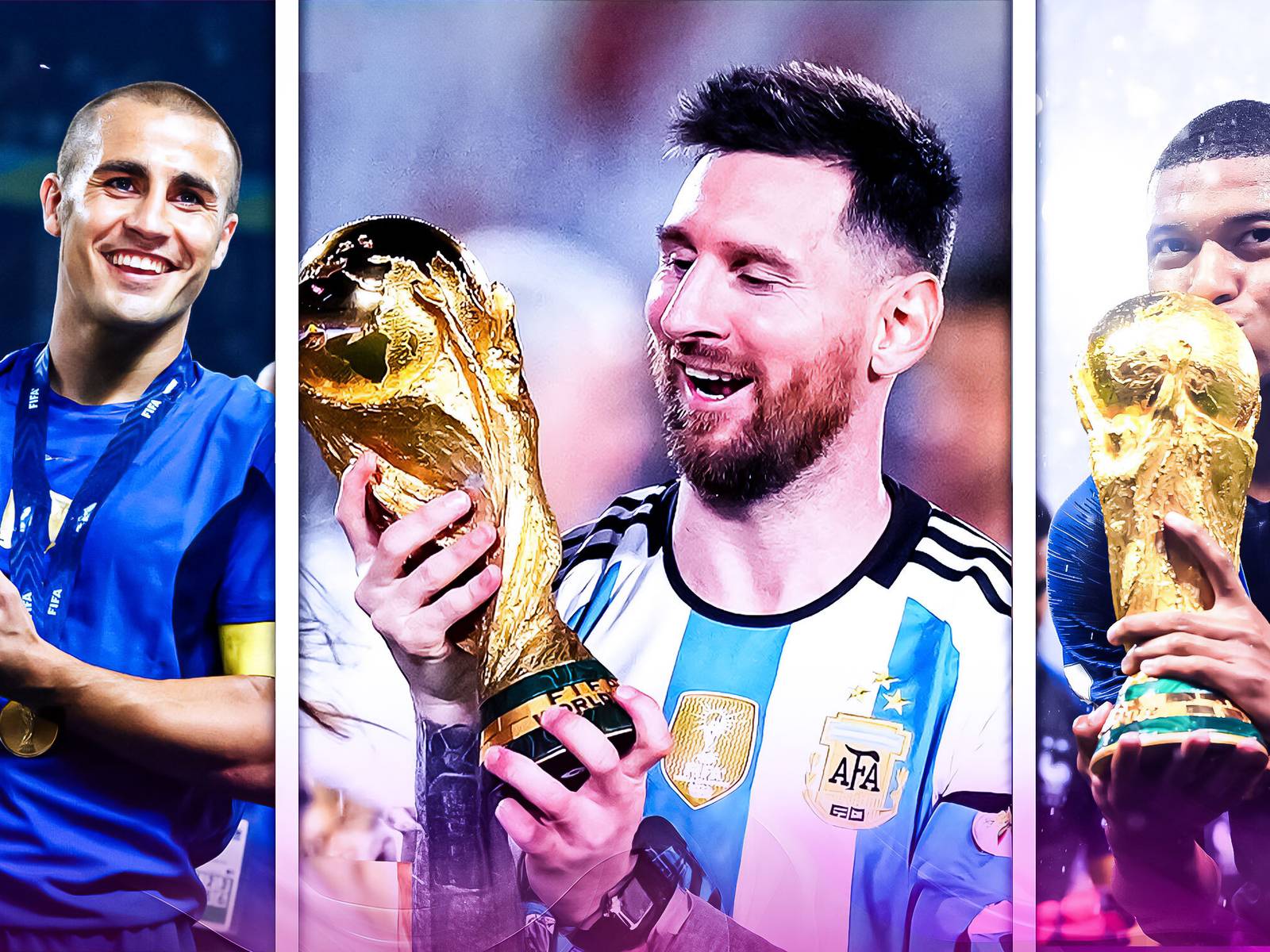
Past winners (Image: givemesport.com)
Part II: The Exclusive Fraternity (Past Winners)
Only eight nations in the history of the sport have ever engraved their names onto the solid-gold trophy. As the footballing world descends upon North America, defending champions Argentina are prepared to guard a crown that belongs to a remarkably exclusive royal lineage:
- Brazil (5 Titles): 1958, 1962, 1970, 1994, 2002
- Germany (4 Titles): 1954, 1974, 1990, 2014
- Italy (4 Titles): 1934, 1938, 1982, 2006
- Argentina (3 Titles): 1978, 1986, 2022 (Defending)
- France (2 Titles): 1998, 2018
- Uruguay (2 Titles): 1930, 1950
- England (1 Title): 1966
- Spain (1 Title): 2010
Part III: The Global Power Rankings: Hierarchies of the 48
With 48 teams in the mix, the traditional international ecosystem has experienced a tectonic shift. Based on recent qualification execution and continental form, the field can be separated into four distinct psychological tiers:
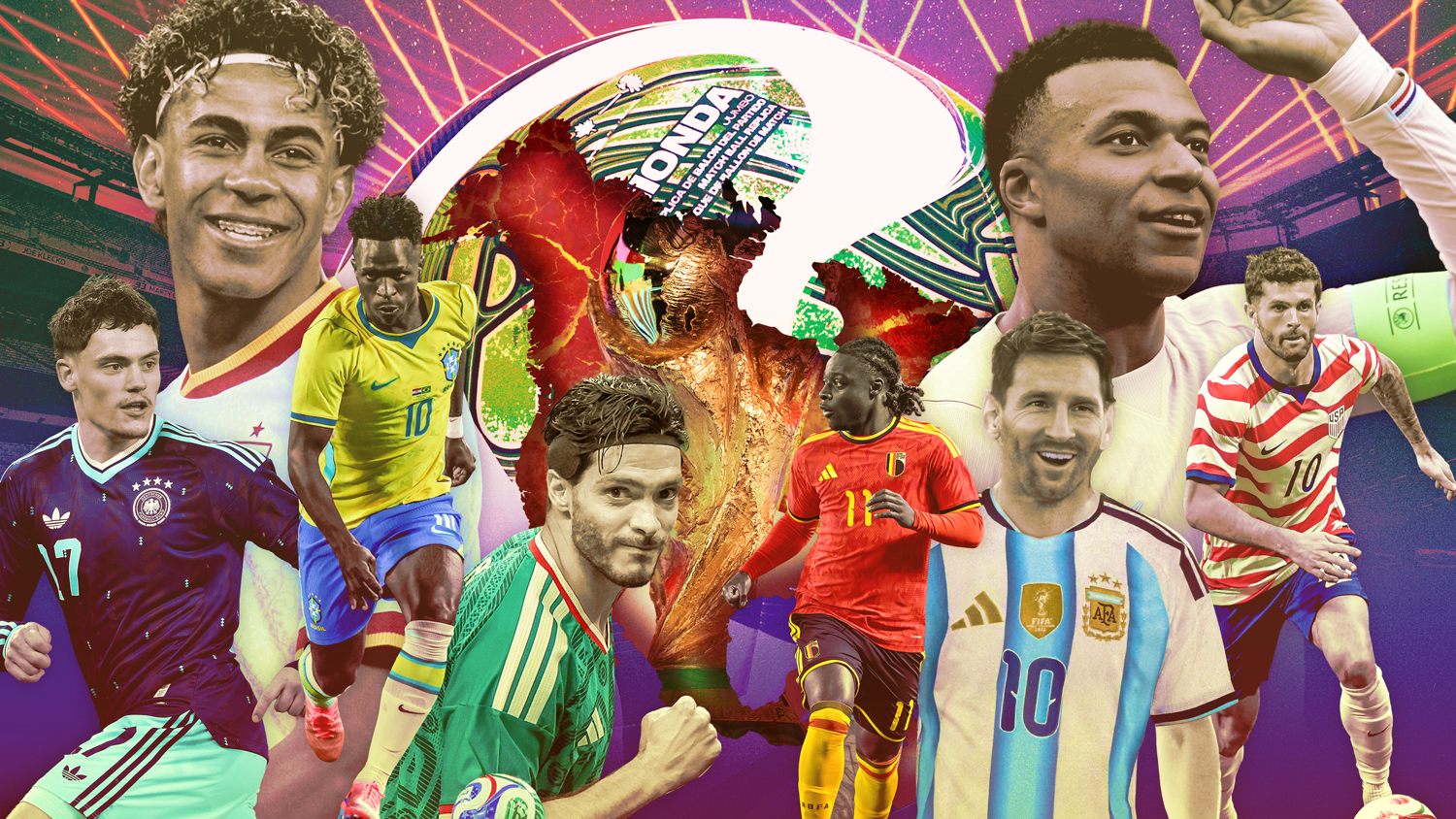
Stars to watch (Image: ESPN)
The Contenders (The Title Heavyweights)
France remains the golden standard of tournament football, boasting a terrifyingly deep talent pool anchored by the peerless Kylian Mbappé, Michael Olise, Desire Doué and Ousmane Dembele, off the back of a back-to-back UCL title. Alongside them sits Argentina, though Lionel Messi is playing his final international chords, manager Lionel Scaloni has surrounded him with an incredibly gritty, functional, and fiercely loyal engine block, including Julian Alvarez, Giuliano Simeone, Nico Paz, and Lautaro Martinez. Spain arrives fresh off their recent European triumph, playing a modern, beautiful brand of positional football that suffocates opponents. Then there is Brazil, an apex predator carrying the devastating 1v1 isolation threat of Vinícius Júnior and Igor Thiago, Raphina, Gabriel Martinelli and the talismanic Neymar, who might be having his last dance.
The Outside Chances (The Elite Flirts)
England enters the tournament armed with a staggering generation of individual brilliance, including Jude Bellingham, Harry Kane, and Bukayo Saka, but they must still prove they can break their historical psychological ceiling in a hostile away environment. Portugal shares a similar fate—possessing an absurdly luxurious collection of elite club stars that manager Roberto Martínez is desperately trying to balance. Meanwhile, Julian Nagelsmann has re-engineered Germany into a high-octane machine that is breathtakingly dangerous but remains occasionally prone to defensive transition lapses.
The Dark Horses (The Giant Killers)
Uruguay has become international football’s ultimate nightmare under Marcelo Bielsa, executing a hyper-athletic, high-pressing block that already choked the life out of Brazil and Argentina during qualifying. Colombia enters the tournament heavily backed after going unbeaten through massive stretches of their grueling CONMEBOL run. From Africa, Morocco proves their historic 2022 semifinal run was no fluke, bringing a mature, elite group of European-based stars ready to disrupt the old order once more.
The Pretenders (The Paper Tigers)
Belgium’s revered “Golden Generation” has officially faded into history; while Kevin De Bruyne remains an elite maestro, an aging defensive transition unit leaves them highly vulnerable to younger, faster opposition. Similarly, the Netherlands present a culturally brilliant, aesthetically pleasing outfit, but a glaring lack of a clinical, world-class number 9 could cause them to stall brutally when the fine margins of the knockout rounds take over.
Part IV: Immersive Group-by-Group Narrative & Player Profiles
Under the newly minted tournament format, the old safety nets are gone. While the top two teams from each section gain automatic passage, a frantic mathematical scramble will see the eight best third-placed teams crawl forward into a brand-new, single-elimination Round of 32.
Group A: The Co-Host’s Crucible
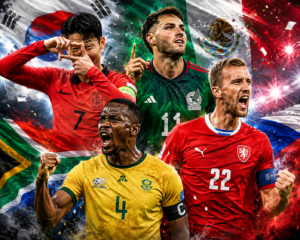
The tournament ignites in a cauldron of noise at the Azteca as co-hosts Mexico square off against a remarkably physical, athletic South Africa side. This section promises zero breathing room, operating as a highly competitive environment where every point will feel like a knockout fixture. The structural discipline of Czechia will look to stifle their opponents, but the heavy favorites to top the group remain South Korea.
- Players to Watch:
- Son Heung-min (South Korea): In what will likely be his final World Cup bow, his world-class execution on the counter-attack will determine if South Korea tops this group.
- Santiago Giménez (Mexico): The focal point of the Mexican frontline, whose predatory instincts inside the box carry the hopes of the host nation.
- Teboho Mokoena (South Africa): A midfield general capable of dictating the tempo and unleashing devastating long-range strikes.
- Tomáš Souček (Czechia): The aerial powerhouse and engine of the Czech midfield, crucial for breaking up transitions and crashing the box.
Group B: The Great White North
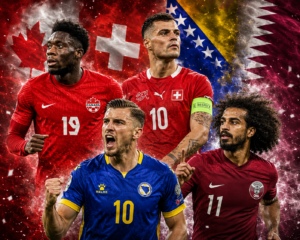
On Canadian soil, Canada steps into the global spotlight, facing an intricate, highly organized chess match. The undisputed heavyweights of this section are Switzerland, a notoriously stubborn, tactically rigid tournament team that excels at strangling high-scoring attacks. Bosnia and Herzegovina will bring a bruising, physical European edge to the pitch, while Qatar arrives with deep tournament familiarity.
- Players to Watch:
- Alphonso Davies (Canada): Operating as the electric engine of his national team, Davies will use his world-class, explosive pace from deep to carry his nation forward.
- Granit Xhaka (Switzerland): Coming off immense domestic success, his elite mental fortitude and deep-lying playmaking will captain the Swiss machine.
- Ermedin Demirović (Bosnia and Herzegovina): A physical, clever striker who provides the ultimate target-man outlet against rigid backlines.
- Akram Afif (Qatar): The continental maestro whose elusive movement and creative vision are vital for Qatar’s transition plans.
Group C: Sensation in the Sunshine
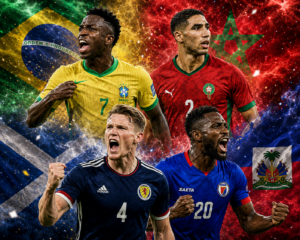
Group C offers a certified blockbuster that has tacticians salivating: a heavyweight collision between five-time world champions Brazil and the defensive architects of Morocco. This is a beautiful contrast of styles, pitting the Samba flair of the Seleção against a Moroccan side that turned defensive solidity into an art form in Qatar. Watching from the wings are Scotland, backed by a raucous, traveling army of supporters and deep physical resilience, and debutants Haiti, who face a monumental test.
- Players to Watch:
- Vinícius Júnior (Brazil): With the weight of the attack on his shoulders, his 1v1 isolation dominance will be relied upon to break down tight defensive blocks.
- Achraf Hakimi (Morocco): The world-class right-back whose lung-bursting overlapping runs and defensive recovery speed anchor Morocco’s tactical structure.
- Scott McTominay (Scotland): The clutch, late-crashing midfielder who found a prolific goalscoring boots during European qualifying.
- Duckens Nazon (Haiti): The veteran talisman upfront, charged with converting the rarest of half-chances for the ultimate underdogs.
Group D: Star-Spangled Ambition
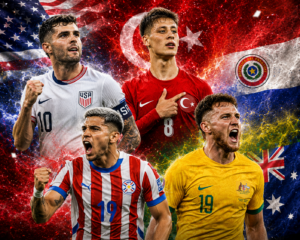
The United States anchors a highly technical, emotionally volatile sandbox. They face a glittering, high-pressing Türkiye side that specializes in fluid, aesthetically beautiful passing sequences, making their matchup an absolute must-watch. Adding to the chaos is Paraguay, who brings traditional South American defensive cynicism, tactical fouling, and immense grit, while Australia remains the ultimate tournament meritocracy—unforgiving, intensely hard-working, and lethal on set pieces.
- Players to Watch:
- Christian Pulisic (USA): “Captain America” arrives in the peak form of his career and must carry the creative load under a microscope of intense domestic pressure.
- Arda Güler (Türkiye): The generationally gifted playmaker whose sublime vision and magical left foot make Türkiye incredibly dangerous in tight spaces.
- Julio Enciso (Paraguay): An unpredictable, explosive young forward who can create goals out of absolutely nothing from long distance.
- Harry Souttar (Australia): A towering 6’6″ central defender who turns every offensive and defensive set-piece into a code-red emergency for opponents.
Group E: Heavy Metal Football
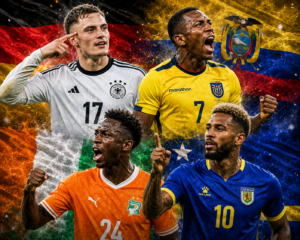
Three-time winners Germany find themselves dropped into a group that functions as a structural speed-test. Julian Nagelsmann’s men will have their defensive transition unit thoroughly cross-examined by two of the most athletic, vertical transition teams in the modern game: Ecuador and the Ivory Coast. While the European giants are heavily favored on paper, any defensive complacency against the explosive Ivorians or the disciplined pressing of Ecuador will result in disaster. For debutants Curaçao, the group represents a historic, albeit terrifying, trial by fire.
- Players to Watch:
- Florian Wirtz (Germany): The creative crown jewel whose sublime spatial awareness allows him to operate flawlessly between enemy lines. Though he had a below-par performance in his debut season in the Premier League with his new club Liverpool, his abilities can’t undermined.
- Pervis Estupiñán (Ecuador): A relentless, modern left-back who provides both elite defensive shielding and pinning width in attack.
- Simon Adingra (Ivory Coast): The electric, trick-heavy winger who terrorizes full-backs and thrives on high-stakes tournament stages.
- Juninho Bacuna (Curaçao): The technical heart of the island nation, trusted with maintaining possession against elite pressing networks.
Group F: The Technical Masterclass
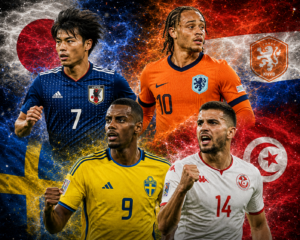
From a purely tactical perspective, Group F is a fascinating study in footballing philosophy. The Netherlands enter as the traditional powerhouse, but they share the pitch with a hyper-disciplined, relentlessly pressing Japan side that specialized in slaying European royalty back in 2022. With Sweden providing a robust, physical defensive template and Tunisia offering immense tactical discipline, there is virtually zero margin for error here.
- Players to Watch:
- Kaoru Mitoma (Japan): A literal master of dribbling dynamics whose unique ability to manipulate a defender’s body weight can unbalance the tightest structures.
- Xavi Simons (Netherlands): The energetic, multi-functional creative engine who drives the Dutch transition from midfield to attack.
- Alexander Isak (Sweden): A silken, highly clinical striker whose movement off the shoulder of central defenders is completely elite. Hoping he could shake off his lengthy layoff during the just concluded Premier League season and put up performances he’s reputable for.
- Aïssa Laïdouni (Tunisia): The combative, hard-tackling midfielder who embodies Tunisia’s fierce competitive spirit and structural grit.
Group G: The Red Devils’ Reset
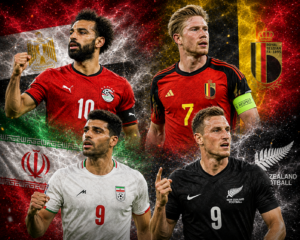
Belgium enters their post-Golden Generation reality under an intense microscope, finding themselves in a group meticulously designed to frustrate them. They must navigate a deeply compact, suffocatingly organized Iran side that prides themselves on low-block defensive clean sheets, alongside an Egypt team engineered to sit deep and strike like a cobra on the counterattack. Heavy underdogs New Zealand, round out the group, hoping their immense physical height can cause chaos from set-play routines.
- Players to Watch:
- Mohamed Salah (Egypt): One of the undisputed icons of modern football, whose supernatural ability to create goals out of nothing makes Egypt an absolute wild card.
- Kevin De Bruyne (Belgium): The veteran maestro whose telemetry-like passing accuracy must unlock ultra-low defensive structures.
- Mehdi Taremi (Iran): An intelligent, physically imposing forward who excels at hold-up play and drawing crucial fouls in the final third.
- Chris Wood (New Zealand): The lethal Premier League veteran who requires only a fraction of a chance in the air to punish defensive errors.
Group H: The Clash of Eras
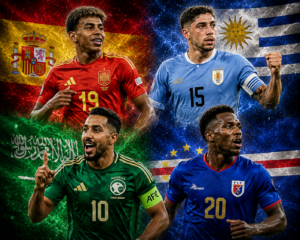
Group H treats fans to a spectacular, romantic war of styles. On one side stands Spain, looking to completely freeze the tempo of matches by demanding 70% passing possession. On the other stands Marcelo Bielsa’s Uruguay, a pack of hyper-athletic wolves who want to turn those exact same matches into chaotic, high-intensity brawls. This leaves Saudi Arabia and tournament debutants Cabo Verde facing a massive mountain to climb.
- Players to Watch:
- Lamine Yamal (Spain): The teenager has taken world football by storm; his directness and generational vision provide Spain with the sharp, vertical edge they historically lacked.
- Federico Valverde (Uruguay): The lung-bursting, box-to-box powerhouse who perfectly translates Bielsa’s high-octane physical demands onto the pitch.
- Salem Al-Dawsari (Saudi Arabia): The iconic wizard of Saudi football, remembered forever for his Qatar 2022 heroics, looking to repeat history.
- Ryan Mendes (Cape Verde): The ageless, inspirational captain leading the blue sharks into their historic maiden World Cup voyage.
Group I: The Group of Death
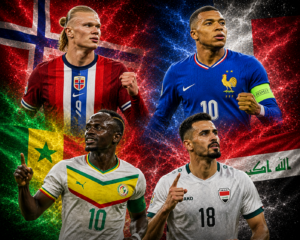
There is always one section that feels like an absolute gladiatorial pit, and in 2026, it is Group I. It features a historic, emotionally charged rematch between France and their 2002 conquerors Senegal, alongside a Norway side that possesses the single most terrifying weapon in world football. Iraq will have to play the tournament of their lives to avoid being completely swept away by the sheer attacking firepower around them.
- Players to Watch:
- Erling Haaland (Norway): Having been starved of a major international platform, the Nordic striker is finally loose. If Norway can feed him consistently, he can shatter tournament records.
- Kylian Mbappé (France): The tournament’s ultimate alpha predator, looking to seal his immortality by dominating yet another global campaign.
- Sadio Mane (Senegal): A dynamic, physical forward whose combination of press-intensity and link-up play leads the Teranga Lions’ frontline.
- Aymen Hussein (Iraq): A clutch, physical target-man whose aerial prowess carried Iraq through highly dramatic Asian qualification rounds.
Group J: The Last Dance?
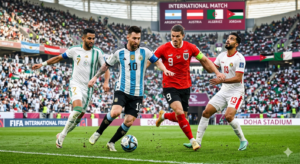
The footballing gods were in peak poetic form when drawing Group J. Lionel Messi’s reigning world champion Argentina begins their title defense against a brilliant, hyper-aggressive Austria team coached by the godfather of Gegenpressing, Ralf Rangnick. It is a fascinating tactical test for the aging champions, made even more complicated by a highly technical, unpredictable Algeria side. For tournament debutants Jordan, the group offers an absolute fairytale matchup.
- Players to Watch:
- Lionel Messi (Argentina): His role has beautifully evolved from an explosive dribbler into a cerebral grandmaster, pulling strings from deep to guide his country one last time.
- Marcel Sabitzer (Austria): The hyper-disciplined midfield engine who triggers Austria’s furious pressing traps and controls transition phases.
- Riyad Mahrez (Algeria): The veteran magician whose elite first touch and trademark cutting-inside from the right wing remain beautifully intact.
- Musa Al-Taamari (Jordan): Nicknamed the “Jordanian Messi,” his explosive dribbling from the flank will be Jordan’s primary outlet to shock the world.
Group K: The Coffee & Carnivals Derby
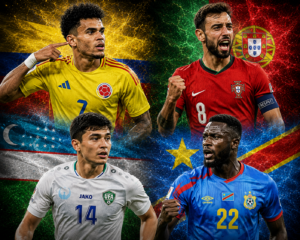
Group K promises to be a vibrant, high-octane affair defined by a marquee showdown between Portugal and Colombia—a fixture that will almost certainly dictate who claims the top spot. However, the true trapdoor in this group is Uzbekistan. The Asian debutants have quietly engineered a formidable, highly disciplined tactical identity and are primed to snatch an automatic qualification spot from the heavyweights, while the DR Congo brings immense physicality and flair.
- Players to Watch:
- Luis Díaz (Colombia): His chaotic, relentless running style and big-game clutch factor make him a terrifying proposition for European backlines.
- Bruno Fernandes (Portugal): The chief creative architect whose high-risk, high-reward passing metrics generate an absurd volume of chances for his forwards.
- Abdukodir Khusanov (Uzbekistan): A rock-solid, immensely mature young central defender whose defensive masterclasses are the foundation of Uzbekistan’s historic rise.
- Chancel Mbemba (DR Congo): The veteran defensive titan and leader who provides the organizational spine and goal threat from offensive set-pieces.
Group L: The Continental Gauntlet
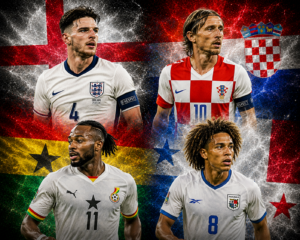
England finds themselves dropped right back into the path of their historical tournament nemesis, Croatia, renewing a deep midfield rivalry that has defined recent tournaments. The path is made significantly more hazardous by the inclusion of Ghana, a side capable of devastating, unpredictable transition play, and Panama, who brings immense physical execution and defensive resilience.
- Players to Watch:
-
-
- Declan Rice (England): The complete modern midfielder. His box-to-box dominance, elite positioning, and natural leadership will be the metric by which England’s entire World Cup success is measured.
- Luka Modrić (Croatia): The ageless, iconic maestro returns to pull the strings in midfield for what will undoubtedly be his emotional final dance on the World Cup stage.
- Antoine Semenyo (Ghana): A dynamic, explosive ball-carrier who can single-handedly break structural midfield lines via pure power and technique.
-
Part V: Critical Tournament Logistics
To combat the reality of traveling across three massive nations and multiple time zones, FIFA has strategically divided the group stage into East, Central, and West regionalized clusters. Teams will remain localized within their geographic zones for their opening three matches, preventing catastrophic travel fatigue before the knockout rounds even begin.
With only 16 teams facing elimination in the group stage, every single goal, yellow card, and corner kick will matter. The goal-difference margins will be checked under a microscope as the twelve groups conclude, revealing which eight third-placed teams survive to enter the chaotic, unyielding drama of the single-elimination bracket. The stage is set, the lines are drawn, and the planet prepares to stand still.