

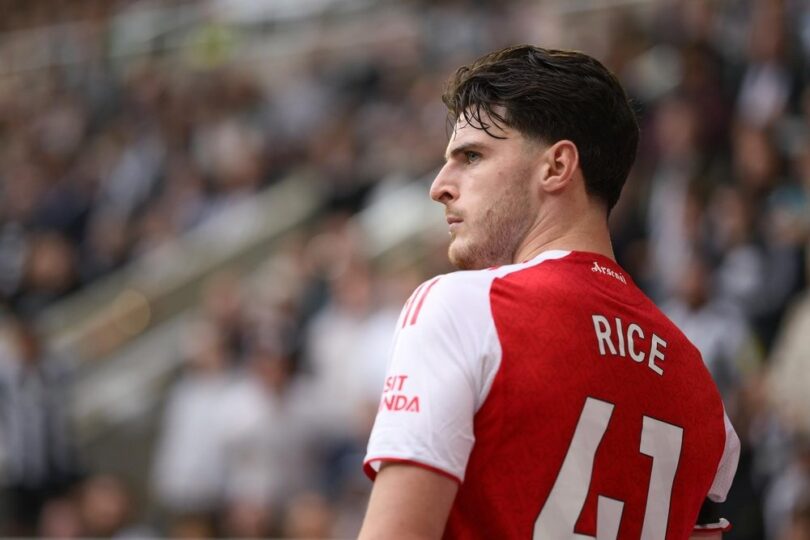

Few careers in modern English football embody the triumph of character over circumstance quite like Declan Rice’s. Once a teenage casualty of the ruthless academy system, he has transformed into the structural foundation of both the England national team and Mikel Arteta’s Premier League-winning Arsenal side.
This profile breaks down his trajectory, his early tactical vulnerabilities, his signature style of play, and how five different managers unlocked separate dimensions of his world-class skill set.
Part I: The Crucible of Rejection & Early Vulnerabilities
The narrative of Declan Rice often skips straight to his leadership at West Ham, but his foundational spark was born out of rejection.
At 14, Rice was released by Chelsea’s academy, the club he had trained with since age seven, alongside his best friend Mason Mount. The official reason cited was a lack of physical development and agility during a sudden growth spurt.

Declan Rice & pal, Mason Mount during Chelsea academy days (thesun.co.uk)
West Ham snapped him up almost immediately, but his rise was not a flawless ascension. Early in his senior career, Rice faced intense scrutiny for high-profile defensive errors. On his first Premier League start on the final day of the 2016/17 season, and early into the 2017/18 campaign under Slaven Bilić, Rice was deployed as a center-back. His lack of natural recovery pace when caught out of position and a tendency to drop too deep, playing attackers onside, exposed him against elite opposition.
The turning point came under Manuel Pellegrini. Recognizing his elite reading of the game but noting his vulnerability when isolated one-on-one against lightning-fast wingers in a low backline, Pellegrini pushed Rice into midfield.
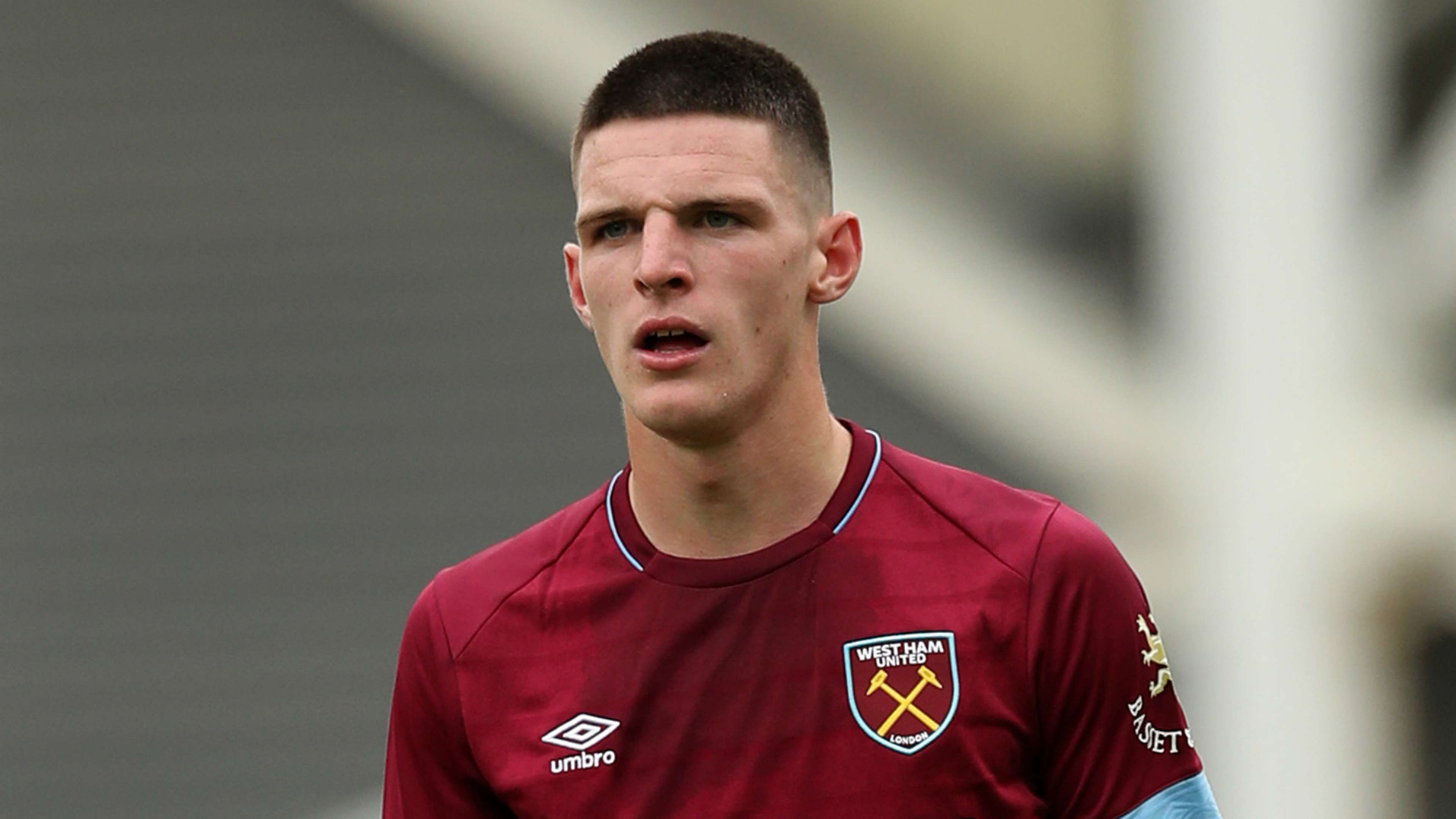
The rising of Rice (Image: goal.com)
Part II: Style of Play & Tactical Profile
To understand Rice’s rise to prominence is to understand a player who bridges the gap between the classic British “box-to-box” warrior and the continental “regista” (deep-lying playmaker).
Declan Rice’s tactical footprint covering the middle and attacking thirds. Source: Reddit
Rice’s game is defined by three elite traits:
- Interception Radius: Rather than relying on sliding tackles, Rice uses long strides and an elite spatial radar to intercept passes before they reach the lines. He consistently ranks in the top 5% of European midfielders for interceptions per 90.
- Ball-Carrying (Progressive Carries): Unlike traditional defensive midfielders who win the ball and lay it off to a creative teammate, Rice drives forward under pressure. His powerful, vertical ball-carrying breaks opposition pressing lines cleanly.
- Aerial and Physical Duels: Standing at 6’1″, he provides a crucial physical screen, winning greater than 60% of his total duels on the pitch.
Part III: The Managerial Blueprint
Every manager who has coached Rice has treated him as a chess piece, evolving his responsibilities to match his expanding tactical maturity.
- Manuel Pellegrini: The Anchor Blueprint
Pellegrini completely saved Rice’s career by moving him out of the back three and permanently installing him as a lone number 6.
- The Deployment: Pellegrini utilized Rice as a pure “destroyer.” His instructions were simple: sit in front of the central defenders, break up counterattacks, and hand the ball to more creative players like Manuel Lanzini or Felipe Anderson.
- David Moyes: The Box-to-Box General
Under Moyes, West Ham transitioned into a lethal counterattacking, low-block side. This environment transformed Rice from a passive destroyer into a dynamic transition engine.
- The Deployment: Moyes paired Rice in a double pivot alongside Tomáš Souček. With Souček acting as the aerially dominant box-crasher, Rice was given the freedom to execute his signature progressive carries. Moyes gave him the captaincy, demanding leadership and driving runs that culminated in Rice lifting the UEFA Europa Conference League trophy in 2023.
- Gareth Southgate: The Conservative Screen
In the international setup, Southgate prioritized defensive solidity over individual expression, looking to protect England’s backline in tournament football.
- The Deployment: Rice was used primarily as a disciplined holding midfielder, often paired with Kalvin Phillips (Euro 2020) or Jude Bellingham (World Cup 2022 / Euro 2024). Southgate restricted Rice’s forward runs, tasking him with recycling possession cleanly and stopping transitions dead in their tracks.
- Mikel Arteta: The Complete Midfield Metronome
Arsenal’s £105 million investment in 2023 was designed to buy tactical flexibility, and Arteta has completely weaponized Rice’s versatility to win the 2025/26 Premier League.
- The Deployment: Arteta has used Rice in two distinct roles. When Thomas Partey or Jorginho starts, Rice plays as a left-sided number 8, where his high-pressing ability helps suffocate teams in their own half and allows him to rack up goals and assists. When playing as the lone 6, he controls the tempo of the game, dictating build-up play and registering a pass completion rate consistently hovering above 90%.
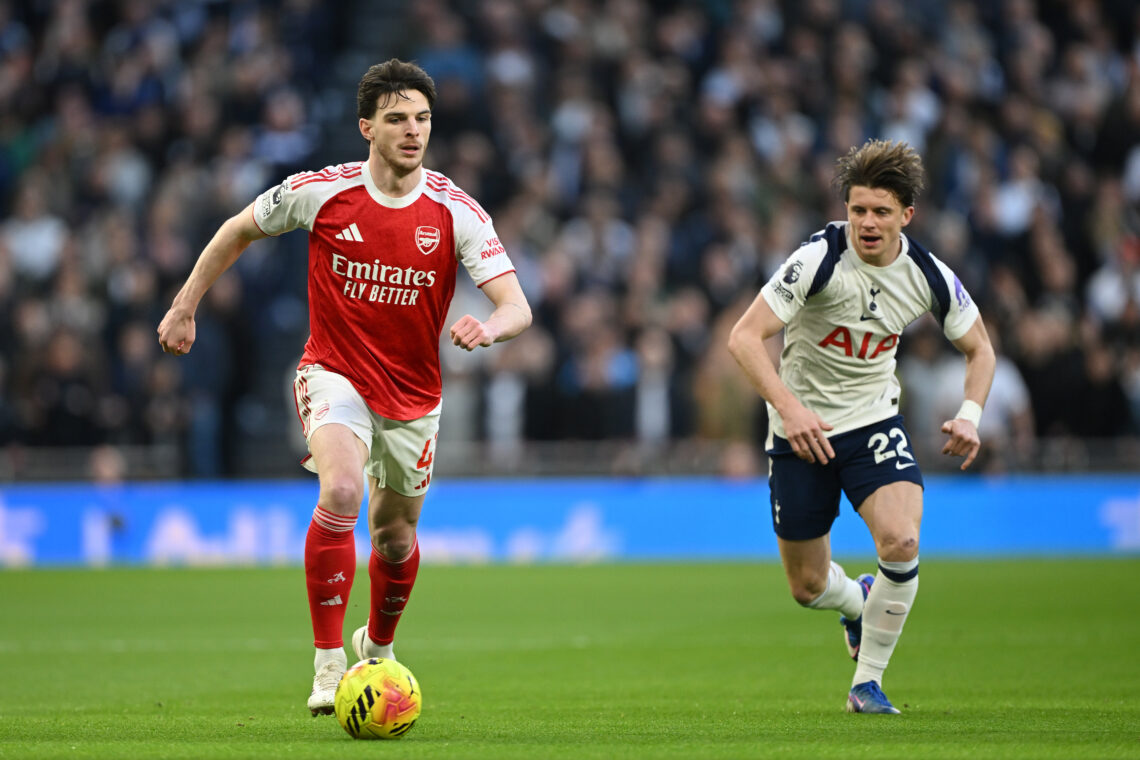
Rice – The Metronome (Image: Mike Hewitt/Getty Images)
Part IV: The Statistical Rise to Prominence
The evolution of Rice’s profile is starkly visible when analyzing his career data. He has evolved from a low-volume passer into a high-output, progressive creator.
| Era / Season | Club | Role | Interceptions (per 90) | Progressive Carries (per 90) | Goal Involvements (G/A) |
| 2018/19 | West Ham | Pure Defensive 6 | 2.1 | 1.4 | 2 |
| 2021/22 | West Ham | Double Pivot 6/8 | 1.8 | 2.9 | 9 |
| 2023/24 | Arsenal | Hybrid 6 / Left 8 | 1.5 | 3.2 | 17 |
| 2025/26 | Arsenal | Premier League Champion | 1.7 | 3.4 | 14 |
The Verdict: Declan Rice is no longer just a defensive shield; he is a tactical Swiss Army knife. By conquering his early academy heartbreak and refining his technical execution under world-class coaching, he has built the perfect profile for the modern era: a midfielder who can win the ball in his own box and create a goal in yours within ten seconds.