

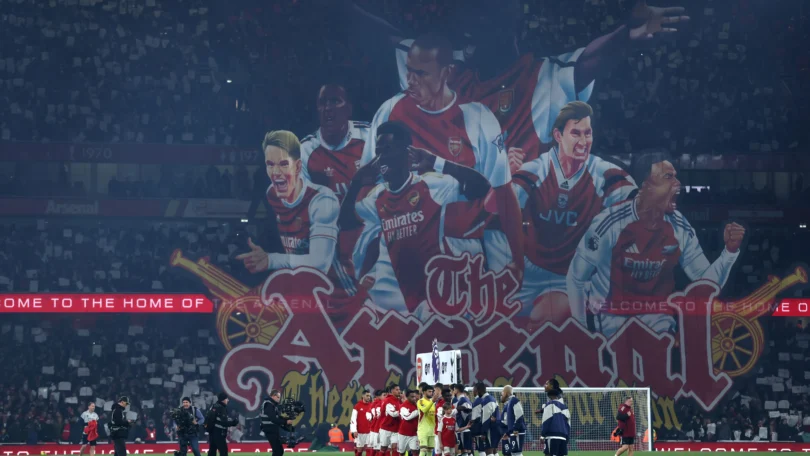

The Emirates Stadium is more than a ground of brick and glass. On matchday, it becomes a living, breathing wall of sound, driven by the people in red and white. This is the story of Arsenal’s Red & White Army and why they’ve earned the title of the 12th man.
From the first whistle to the final chant, their presence shifts the atmosphere inside the stadium. It’s in the roar that greets a surging attack, the unity of a familiar song rising through the stands, and the way a moment of doubt can be drowned out by belief. This ode is for the supporters who turn 60,000 seats into a single voice.
The Name: “Red & White Army”
The nickname “Red & White Army” isn’t officially on the club’s crest, but it’s been earned over decades in the stands. Arsenal’s colours have always been red and white, ever since the club adopted the red shirt and white sleeves in 1933. The fans took that visual identity and made it their own.
“Red & White Army” started showing up in chants, banners, and fan forums to describe the collective identity of supporters, home and away. It’s simple, visual, and unmistakable when Arsenal travel; the away end often looks like a moving block of red and white. The phrase captures both the unity of the group and the military-style discipline of turning up week after week, regardless of form or distance.
It also sets Arsenal apart from generic fan labels like “Gooners.” Where “Gooners” is a term for the individual supporter, “Red & White Army” speaks to the group as a force. It’s a reminder that on matchday, it’s not 60,000 individuals at the Emirates, it’s one army, singing in sync.

Image: Football London
The Glory Days, Then The Grind
Arsenal’s modern identity was shaped by the Wenger era and the 2003-04 “Invincibles” season. That period put the club on the global map and turned millions into lifelong fans. What followed was a stretch of transition: moving from Highbury to the Emirates, years without a league title, and constant debate over direction. The fanbase lived through that dip, boos, protests, and all, but kept filling the ground.

Image: talkSPORT
The Rise to Reckoning
The 2025-26 season is looking to be like the payoff as Arsenal are first in the Premier League, in the Champions League final, and hitting record attendances: 60,345 vs Tottenham, averaging 60,214 in the league. After years of “almost,” the fans who stayed through the rebuild are now watching the club return to the top table. If the trophies come this year, it’s a direct reward to the Red & White Army, who never let the atmosphere drop.
The Fans As The Focal Point
That loyalty shows in the numbers. Arsenal’s global fanbase sits around 116.5M followers across social platforms as of 2026, making them the 10th biggest club worldwide. Other estimates put it at 99.2M and 116.2M. In the UK alone, Arsenal is the 2nd-most-searched club, with 4.3M searches per month. The club is estimated to have about 100M international fans. Those numbers don’t happen without a core that keeps the culture alive during lean years.
Loyalty comes at a cost, sometimes in the form of a price tag, and Arsenal’s is among the highest in England. In terms of season tickets, there was a rise in the 2025/26 ST, which is split into 3% for the upper tier & 5% for the lower tier. This rise is coming after the club froze prices for two seasons prior due to fans’ pushback.
According to sources such as arsenal.com, Greg Snoyman of seatpick.com, and Chris Goodacre from ticket-compare.com, the Premier League average cheapest ST went from £807 in 2024/25 to £866 in 2025/26, up 7.27%, with Arsenal’s still above average but rose more slowly than the league.
Arsenal have the 3rd most expensive season ticket in the league, with the cheapest adult ticket at £1,127 for 19 games. Matchday tickets range from £34 to £158.
On merchandise, per arsenal.com and Daniel Karell of sportingnews.com, the replica home shirts are £85 for Arsenal, putting them in the top tier with Liverpool, Man City, Man United, Spurs, and others. In 2024-25, Arsenal’s replica shirt was £80. The club generated €120M from kit and merchandising sales in 2023-24, 6th in Europe.
Compared to other top clubs, Arsenal are consistently in the top 5-6 for price, but also top 10 for commercial revenue. The trade-off is clear: fans pay more, but the club uses that to compete at the highest level.
The 12th Man Effect at the Emirates
For years, the Emirates had a reputation as a “library.” The move from Highbury, the high ticket prices, and a stretch without trophies left the atmosphere flat. That’s changed under Mikel Arteta. The stadium now feels like the 12th man again, and the 2025-26 season has been the proof.

The 12th man
What it looks like now
On May 5, 2026, Arsenal beat Atlético Madrid 1-0 at the Emirates to reach the Champions League final for the first time in 20 years. The atmosphere was described as the most electric in the stadium’s 20-year history. Bukayo Saka said, “I’ve never seen anything like it. They pushed us and pushed us, and we got this moment at the end. It’s special.”
Arteta was just as direct: “I have never felt that in the stadium. The atmosphere, our support has created the energy, the way they managed every ball with us, they made it special and unique.” He added that the fans “set the standards” and the players tried to catch up.
The shift wasn’t accidental. Before the Atlético game, a bus welcomed by the fan group REDaction Gooners set the tone. The club put messages on the big screens asking fans to be in their seats early and make noise. The tifo read “Over land and sea,” and the ground responded.

Image: Football London
The numbers behind the noise
In terms of attendance, Arsenal averaged 60,214 in the Premier League in 2025-26, with a high of 60,345 vs Tottenham. That’s 99.5%+ capacity, matching the club’s best modern attendances, while Arsenal have won 41 games in all competitions this season, matching the 1970-71 club record. Home form has been central to that. An AI ranking of Premier League stadiums placed the Emirates 11th for loudness in late 2025, noting “Ashburton Army has transformed it; decibels soar with Arteta’s title push, now a ‘carnival’ per William Hill rankings.”
Its Effect on The Pitch
Industry research suggests home crowds influence refereeing decisions in tight games, and Arsenal have benefited from that at key moments. More directly, players say the noise changes their mindset. When the Emirates is loud, players recover faster, press harder, and believe a comeback is possible. When it’s quiet, the opposite happens—jogging, grumbling, and dropped points.
The contrast with the past is stark. Two seasons ago, a goal against would trigger impatience and negativity. Now, even when Arsenal go 1-0 down, the crowd doubles down. That shift is why players and coaches call it a “beautiful inevitability” that the team fights back.
Image: The Guardian
The Payoff
Arsenal are five points clear at the top of the Premier League with three games left, and in the Champions League final for only the second time ever. The Emirates didn’t score those goals, but it created the conditions for them. After years of transition, the Red & White Army has turned the stadium back into a fortress.
Keeping the Spirit Alive: The Future of the Red & White Army
The Red & White Army has been through every version of Arsenal. Invincibles. Transition. Rebuild. Now, reckoning. The question isn’t whether the fans will show up — they always have. It’s what happens next, as the club pushes to turn this season’s momentum into a new era.
The atmosphere at the Emirates has shifted because the crowd has shifted. Arteta and the club have leaned into younger supporters, supporter groups like REDaction Gooners, and pre-match rituals that bring noise back to the stands. Bukayo Saka and the current squad are Arsenal through and through; they grew up in the stands, and that connection feeds the noise. When players and fans share the same reference points, the stadium stops feeling corporate and starts feeling like Highbury again.
Image: Facebook
Arsenal’s reach is now global, with about 116M followers across social platforms and an estimated 100M+ international fans. Most will never set foot in N7, but they’re part of the same army. Watch parties in Lagos, Nairobi, Mumbai, and LA keep the chants alive on matchday. That global base is why the club can sustain high ticket and merchandise prices, £1,127 for the cheapest season ticket, £85 for a replica shirt, and still sell out. The loyalty isn’t local anymore. It’s a network.
Winning as the reward
If Arsenal lift the Premier League or Champions League this May, it won’t just be a trophy for the boardroom. It’ll be a payoff for the fans who kept showing up when the football was mediocre, and the criticism was loud. The 2025-26 season proves what happens when the Red & White Army and the team sync up: 41 wins, a Champions League final, and the Emirates sounding like it did in the Highbury days.

Jubilant 12th man
Sustaining it means keeping the balance. The club has to manage ticket pricing so the core support isn’t priced out. Fan groups have to keep pushing for atmosphere, not just aesthetics. And the team has to keep giving those 60,000 people a reason to believe every ball matters.
The Emirates finally feels like home again. If Arsenal can hold onto that, the Red & White Army won’t just be a chant. It’ll be the reason the next decade looks different from the last.